Monday, October 20, 2014

transforming life


Life is an adventure that has to be found. If not fought for and looked for, life can slip away leaving one lost and trapped in a monotones life. Mise en scene teaches to look for life through film. The film Secret Life of Walter Mitty teaches how to look at life closer. “To see the world, things dangerous to come to, to see behind walls, draw closer, to find each other, and to feel. That is the purpose of life.” The film uses frames and colors to show Walter Mitty's transformation into life.


The Secret life of Walter Mitty, lives most of his life in wishes and dreams. He wishes for life throughout daily living, and it takes a huge worldly adventure to give him a sense of being alive. Mise en Scene captures the life of Walter Mitty, or the lack of it, and the comparison of the two. At the beginning of the film Walter Mitty has an absent life full of monotony working for life magazine. In the very first scene he is trapped. The different bars and symbols of prison are trapping him in his life. The grey colors above show just how boring his life is. He is trapped behind a computer screen, showing how caged he is and fundamentally lonely.


When he looks really closely at photos for the cover, even though he's looking closely at life and beauty, he misses it all. Walter Mitty doesn't actually have the ability to see life and draw closer because he's too close and missing the most important aspects of it. Mise en Scene portrays this through different shots of the film. In the picture to the left the frame has a very high density of texture. The high density of texture and depth of the frame is a representation of the high density of stuff life has to offer. The fact that Walter is looking so closely at the missing photo is a parallel to how he sees life. Walter is so intent on looking in a small space that he misses the things all around him. The high density of texture parallels how Mitty is trapped in his job. The defined, vertical lines are like jail bars, trapping him in a dark cave, the darker side of life. The darkness of the room represents a darkness in his life, an absence of light and joy that he so wishes for. There isn't enough light to shine on what's really important. When he's in Ireland, He learns to see things he wasn't able to at home and work. The scene of him skateboarding down a hill is a scene filled with Mise en Scene showing how he breaks free and sees life from a new perspective. In the picture to the above right he is shown in a variety of of wide, loosely framed shots. This is a huge comparison of the two ways of how to live life. The open form is a symbol for how wide his eyes are opening. Mise en scene gives an idea of Walters life transformation, from none to all.




Throughout the film, Secret Life of Walter Mitty, Mitty get lost in daydreams. The daydreams are callings from his inner soul of who he's supposed to be. He dreams of wild adventures and gets lost in real life because of that. The shot to the left shows Mitty in a position of excitement and adventure. However, it is just a daydream. The scene this shot protrays is not real, it is simply what he wants to be real. The aspect ratio is one of a close up making him seem present and exciting. It fantasizes who he wants to be. He is a large figure in the shot. This gives him a sense of power and presence, even though in the real world he’s the opposit. In reality he is distant from the world. The shot to the right is a shot of the true state of his being. The highly symmetric shot represents the simplicity of his life. He is zoned out and disconnected from the world completely. The background, moving in a blur while he's still, shows just how disconnected from the world, and his inability to move in it. His life requires action and adventure and the lack of it stagnates him. When he does find adventure, he finds life, as represented in the picture below, Walter needs life. The picture of him jumping out of a helicopter introduces the transformation he goes through in his adventure. The zoomed out picture shows just how much excitement there is around him. It is an epic shot of a hero or an adventurer. The light in the sky to the lower right shows the light beginning to break out into his life. It is the dominant contrast between his past life and his new life. His old life, dull, boring, dark and grey, the new life full of life and adventure. The picture itself is a dramatic context. he is dramatized, literally jumping out of a helicopter into a boat. In this picture he is gaining life. Something he never had before.


Mise en Sene tells the adventure of Walter Mitty finding life. Life is full of adventure and people, love and light. But it requires danger and adventure to live a fulfilling life. The Movie Secret Life of Walter Mitty gives a great story of finding life. Life that has to be fought for. Life that is just waiting to be discovered. Love, loss, pain and adventure are all needed to make life life. All needed to keep people alive.

Tuesday, October 14, 2014

Crosses and Cages


Life often traps characters in heartbreaking situations. In the Film Mystic River the characters are trapped by life and love. After Jimmy' daughter dies he is trapped by the police, restrained fro, seeing her body and entering the crime scene. In the picture to the left you see Jimmy completely trapped and closed in by the police men. The closed in frame traps him with in the frame as well. the frame is close enough that only Jimmy and his cage of police fit in it. Jimmy's distressed face shows just how much pain he's in over the loss of his daughter. His love for his dead daughter is trapping him in a circle of grief, pain and loss. 


Even from before her death, his love for her trapped him. The fear of loosing her traps him, and continues to trap him through her death. In the shot on the left, Jimmy's daughter traps him in a loving embrace. His daughters body encases his head in a frame, keeping him where he is. Her slight smile indicates her knowledge of he departure, trapping him in ignorance until long after her death and he finds out why she ran away from home. This shot is a parallel shot to when he was trapped by the police, both times he is trapped by his love for her. 


From the very begging of the film, when the characters are still children, Dave s trapped. At the beginning when Dave is being abducted, he is trapped from that moment and from that point on. The shot to the right shows Dave's entrapment in the car. Not only his he trapped by the frame of the car, restricting his space within the frame, but He's also trapped between his two captors. The captors drive him away stealing his innocence and trapping his life.


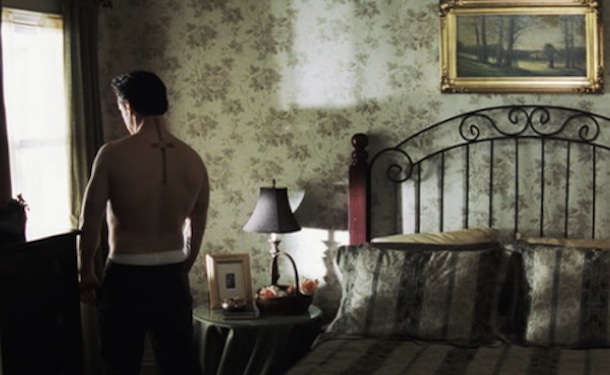
Crucifixion is a constant theme throughout the film Mystic River. The characters trapped in the film are crucified by the end. Part of them goes through a painful death of crucifixion. To the left, Jimmy is shown with a cross tattoo on his back. The cross is the traditional method of crucifixion, making its symbol. The cross on his back shows the crucifixion of a part of him in the loss of his daughter. A part of him died, was crucified, along with his daughter. The cross is to show that part of him has died, and is dying.
Dave was crucified at a very young age. Most of him died when he was driven away by his captors. When Dave is captured in the car, the second of the captors turns around and shows a golden ring with a cross on it. This cross symbolizes the crucifixion of his innocence. The captors crucified him, turning him into a walking dead man for the rest of his life. The ring symbolizes the pain and suffering Dave went though with them. It shows that He died at this point in life.
From the very beginning Dave was marked for death. In the shot to the left Dave has on a bright ed baseball cap. It is the only bright color in the whole shot, consequently standing out and drawing attention. The red baseball cap is a mark, as if he was marked for death and crucifixion all along. The characters underwent crucifixion throughout Mystic River as they all ended up a form of death.

Monday, October 13, 2014

Isolation


Isolation is prominent for the character Margot in  The Royal Tenenbaums. Her isolation from the family is prominent from the very beginning of her childhood. From the very beginning she was introduced as the adopted daughter. This separates her from the other siblings of the family. Being identified as the adopted daughter builds a wall from her and her family, a constant reminder that she never really belonged and never will belong. She is often shown distant from the family in the shots, not directly in the circle, just barely on the outside.  Even in the poster she is off to the side. She is even less connected from the center of the family than her mother's boyfriend. her isolation continues throughout her life and into her marriage. She is develops to habbit of locking herself in the bathroom alone. isolating herself from the world and her husband. This creates a huge distance between the two as shown in the picture below. The huge space filled with random messy junk shows the distance between the couple and the developing problems because of it. Margo's Isolation exists throughout her life, developing from an isolation as a child.


Eli Cash has his own form of Isolation. He suffered from isolation and separation from the Tenenbaum family because he never belonged. Eli Cash, from early childhood has spent his time and life pretending like he does belong, even when he doesn't. This set him up for a life time of pretending. Pretending to be someone he isn't. He is always seen wearing his cowboy outfit and hat. He pretends to be a cool, rough cowboy from the west, even though he's never even been there. His outfit is a symbol for how hard he tries to fit in and be accepted. He takes his whole personality to the extreme that everything he does is a dramatic act. He poses in almost every shot of him, forcing himself into an image of being cooler than he actually is. His every action, including the above shot, demands attention and recondition. Through this mask he puts on himself of being great and mighty, He is really just lost, helpless and looking for a sense of purpose. The above shot shows him in completely helpless from above. He seems to be falling, reaching up for someone to finally help and recognize him. Eli is lost completely with his isolation from the tenenbaoums family. His Isolation creates the problem of constantly needing to be recognized, because he was never truly recognized by them.


Sunday, October 5, 2014

Justificaton

Photography is a tool used in film to portray important aspects of a film and debate key ideas. Key ideas such as ethics are debated through the tool of photography and lighting in films. This is shown true in The Usual Suspects, Eternal sunshine of a spotless mind and Gladiator. these films debate ethics and the ideas of what's morally right and wrong, and whether or not actions are justified.

In Usual Suspects the audience is given a sense of pride in the character of Kaizer Soze. Though everything Kaiser Sose does is considered morally wrong by most, but by the end of the film the audience roots for him. The audience justifies everything Keizer does. The use of lighting and photography through the film gives this sense to the audience. This comes along first with the ambiguity of Keizer’s identity. At the very first scene when Keizer kills Keanon. Keizer is shown in a position of power over Keaton. Keizers face is never shown through his entire persona in a cape of low key lighting, and his identity never given. The low key lighting gives him a domineering figure, at this point he is seen as a devil figure. With fire in the background, and high contrast lighting he seems to be the devil himself. The high angles of him on a balcony peeing on fire, gives him a sense of complete and total power over everything. This power is not justified yet to the audience, yet it isn’t condemned. So the idea of Keizer has the possibility to be a good one, with his total power. The justification begins when the audience meets Verbal, a mostly helpless cripple. Through getting to know verbal, he is shown in many high angle shots, making him seem helpless in the hands of others. He is the underdog, and the forced narrator story of the film. Telling the story through fake fear of the cop. The Audience roots for Verbal is as a character through his perceived innocence, illustrated  through cool colors that show peace and innocence. The expression, through the use of innocence, encourages the audience to care about Verbal as a character and the events that happen to him. So when it’s descovered that Verbal is indeed Kaizer Sose, the audience is already attached to the character, and internally rooting for him, simply because of the underdog effect. So when Keizer wins, Verbal wins, meaning the underdog wins, and everyone loves an underdog. This allows for a celebration of his victory, and a justification of all his wrongdoings...


Technology with the power to manipulate memories, and therefore love, is an ethical debate being argued through the film Eternal Sunshine of a Spotless Mind. The argument is that in the end it is justified because love will prevail, even with lost memories. When going through the journey of his relationship with Clementine, Joel realizes that the memories are worth keeping, the good and the bad. The formalistic cinema, gives metaphors for their relationship. When Clementine is in the process of being taken, she literally slides back, and is forcefully taken from him. The camera then shows Joel in a long distance birds eye shot, leaving him in a sense of complete helplessness, loss, and loneliness with the process of Clementine being ripped from him. After Joel wakes up from the process of his memories being erased, he is surrounded in his room of cool colors, leaving it to just being only him. However some small symbols of bright, warm colors, representing Clementine are left in the room, showing that even though her memories have been stolen from him, her presence, and his love for her remains. Love will prevail through any turmoil, justifying the erasing of the memories. Joel and Clementine’s relationship was one of love and passion rather than convenience. Their relationship is stronger than the erasing of each other's memories, and that gives them the chance to renew their relationship

Honor and Justice are the key ideas argued throughout the Gladiator. The actions of Maximus are justified by the end of the film because Honor for Rome wasachieved in the end. The death of Commodus is justified through the idea of him being an awful human being and a hinderance to Rome.This is shown throughout the film through the use of photography. The opening scene begins with a gruesome war scene presenting the  questions of justification, as well as  how much  a life is really worth. The use of slow stock captures the vivid colors and intensity of the war,Giving the audience insight into what it felt like and/as well as its intensity . This poses the question of whether or not this war is justified, whether the death and loss is justified. Commedos is given the characteristics of a complete villain, with all of his actions unjustified, leaving him very flat as a character. All of the people he indirectly killed through the legalization of gladiator arenas justified his death in the arena. Maximus’s killing of strangers in the arena is justified to get a revenge on Commedos. The loss  of his Wife and son also justify the revenge on Commedos. The loss is protrayed through a hazy filter, showing the loss of clarity he got on life with their loss, giving him only one goal,revenge on Commodus, who took everything from him, and to restore Rome. This scene of his family's death justifies all of the people he killed himself.